The work, decision by decision
1. Sources and uses. What was known: the target size, the strategy, the target properties. What was not: whether the offering was priced right for its risk, or whether interested investors were going quiet for reasons that had nothing to do with the deal. I wrote the capital stack at category level first and built everything else against it. The categories are below; the shares stay inside the offering document.
| Sources of capital | Uses of capital |
|---|---|
| Limited partner commitments, the majority of the raise | Land acquisition and entitlement: custom-home lots in Las Vegas and Ascaya |
| General partner co-investment, a minority of the raise | Construction and development cost, drawn per project as each moved past term sheet |
| Project-level construction debt, arranged per project and not part of the fund raise | Fund-level operating cost: sourcing, diligence and investor relations |
| Reserve against construction overrun and schedule slip |
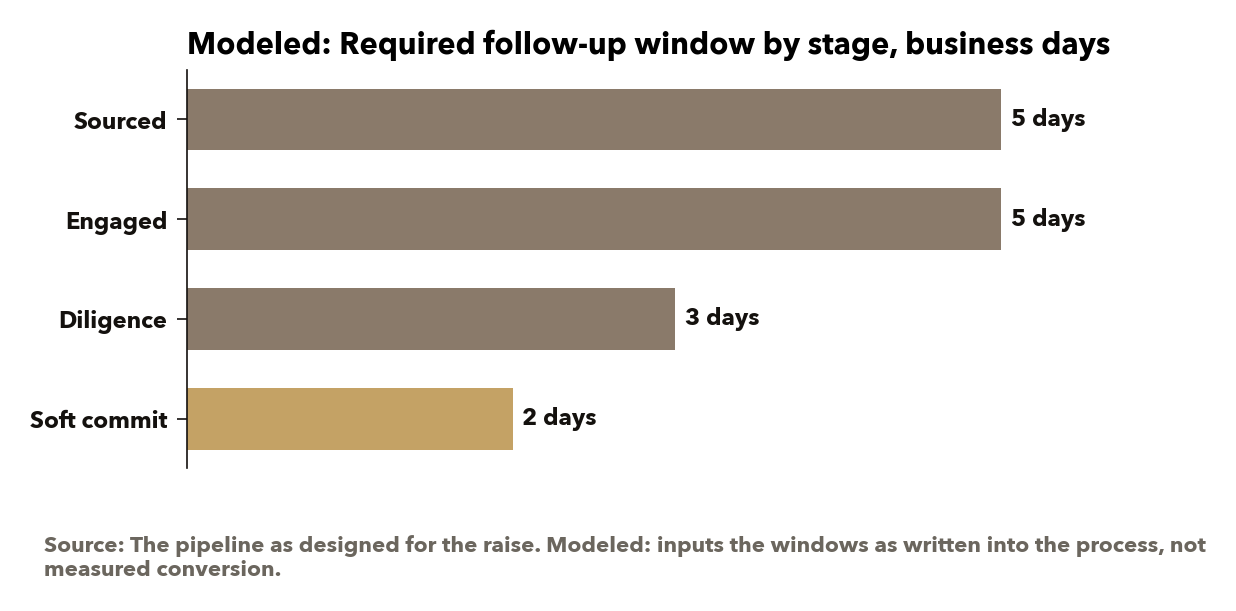
2. The stages. The question: what has to be true for an investor to move, and what is the required next step at each point. Sourced, engaged, diligence, soft commit, closed, each with an entry trigger, a required action and a window. Before this, the diligence and soft-commit stages were tracked informally, and a share of interested investors got no defined next step until they reached back out on their own. That is the specific gap the design targets. Attachment A is the playbook.
3. The cadence, as a design. The windows in the figure are what I wrote into the process. They are a design, not a measured result, and the figure says so.
4. The deck and the financials, rebuilt to the process. The deck's order followed the questions a diligence-stage investor asks, in the order they ask them: why this market and why now; who is running it; which deals the money goes into; where my check sits against construction debt and the sponsor's own money; what return I am underwriting; what happens after this meeting. Common Ground's brand and narrative work shaped the market and sponsor sections; the capital structure, pipeline and process sections came from the strategy work. The financial model's draw schedule was tied to deal stage, so a project moving from term sheet to closed triggered a draw in the model instead of a date on a calendar, and the construction debt cost assumption was rebuilt against the rate environment of the period, which moved against developers through the window. The structure is Attachment B, and the finished deck, version 3G, is attached whole as Attachment C.
5. The PPM. Created, then revised as the raise moved. The revision aligned the offering document's structure to the capital stack and set the point where subscription documents go out to the soft-commit trigger in the pipeline, rather than treating the legal document as fixed and building the pitch around it. Outside counsel held the document; I held what it had to line up with. No term of it appears here.
6. The marketing effort. Built to feed named prospects into the sourced stage, not to run beside the raise. A private placement that relies on existing relationships cannot widen its top of funnel by advertising, so the campaign's job was to put a name and a warm path on every prospect before the first touch, not to generate strangers.
7. The deal side, read as deal flow and not as conversion. Four custom-home projects reached term-sheet stage during the period. They are evidence the fund had places to put money. They are not evidence that the investor process converted better at any stage, and I never presented them that way. Counting a term sheet as a win is how a pipeline's health gets misstated.
8. The concept. With our team I built a 55-plus community concept for the fund and shopped it in Las Vegas and then in Phoenix. Shopping it in Phoenix is how I first met Jon Armstrong of Armstrong Construction Group, and that relationship carried forward into LÏEF Development.
Nobody in private capital says no. They go quiet, and quiet near the signature is a no.
What the tally showed at the end
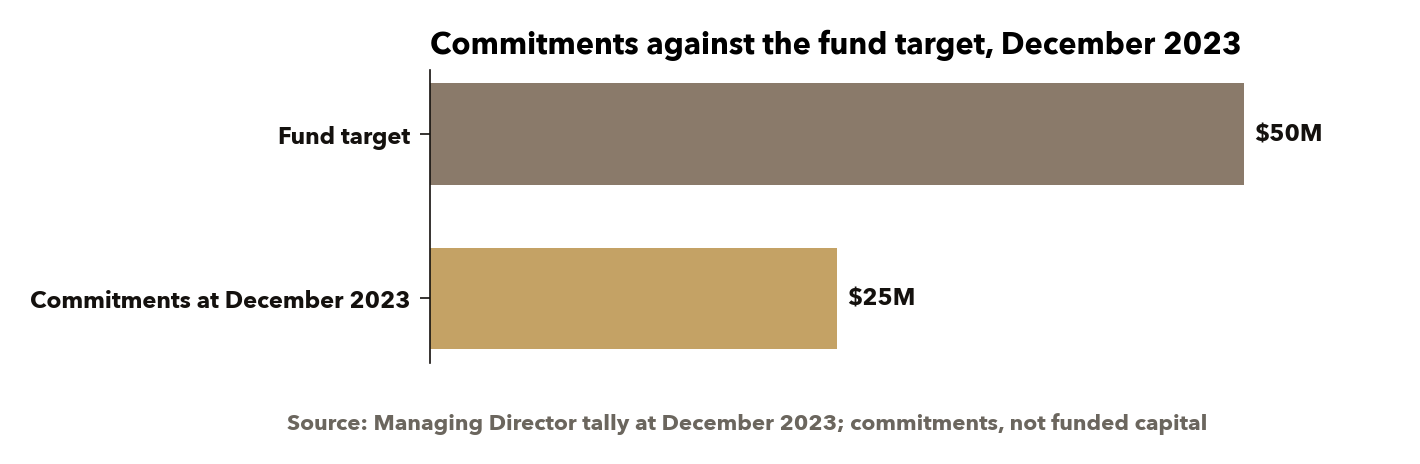
I want to be precise about what that figure is. It is commitments, not closed capital. A commitment is an investor saying yes at a specific price and structure. Funding is a different discipline with its own timeline and its own friction, and treating the two as the same is how a fund overstates itself to the next investor in the room. The commitment figure is the honest one, and it is the only one I report.
The commitments did not fund; the fund did not close near target; I left in December 2023.
The deal side at the end, named as the fund tracked them:
| Project | Structure | Where it stood |
|---|---|---|
| Plaka Del Rey | Custom-home project | Term sheet; did not close with Aycre |
| Modena Court | Custom-home project | Term sheet; did not close with Aycre |
| Sanctuary Peak | Custom-home project | Term sheet; did not close with Aycre |
| Winston Court | Joint venture | Term sheet; did not close with Aycre |
Two things outlived the fund. The cadence, which I have used since. And the relationship with Jon Armstrong, which came out of the concept and not out of the raise.
What we kept, replaced and installed
Kept. The thesis and the relationship list. The thesis was real, and the list was the fund's actual asset. A staged process converts the list it has; it does not grow it. I did not try to change who the fund was for.
Replaced. Conversations as the process. The operators had put nothing in place, which is its own design: the raise ran on whoever remembered to call. The faulty logic was that a strong offering carries its own follow-up. Why it had to change then: the raise was moving slowly against its target with no way to say why, and a raise that cannot say why it is slow cannot be fixed, only hoped at. The deck and model that answered first-meeting questions and gave a diligence-stage investor nothing new to act on were replaced for the same reason.
Installed. Sources and uses ahead of the materials. The staged pipeline with the follow-up rule written down, tracked by hand in a shared pipeline report. The deck order that follows the diligence investor's questions. The draw schedule tied to deal stage. The PPM's subscription trigger aligned to soft commit. No software worth naming. The system was a spreadsheet and a rule: every investor has a stage, and every stage has a next touch with a date on it.
What it cost to hold the line, and what I would watch
A structured process reads as less bespoke to relationships used to informal treatment, and some investors in a raise like this expect to be handled, not staged. That cost is real, and I paid it as administrative weight: every investor's stage tracked by hand, every window watched, every week. The other cost is the one this report is built around. Sequencing the ask before the pitch slows the first month, and a fund that believes its offering sells itself feels that month as lost time.
What I would watch, and what I did not have. The one number that would settle whether the process or the offering was the limit is how many investors who saw the offering passed on its terms, set against how many simply went quiet after a real conversation. Passes point at the offering; silence points at the process. I did not capture that as a count at Aycre, and I would build it into the pipeline report from the first week now. The second thing I would watch is the distinction the figure carries: commitments are not capital until they fund, and a raise should report both numbers to everyone, including itself. The third is what I took into the next seat. Capital arrives with a return it needs, and the return decides what gets built. On the development work that followed, I put capital last, after site control and a proven model, and that order came from this seat.
What it produced
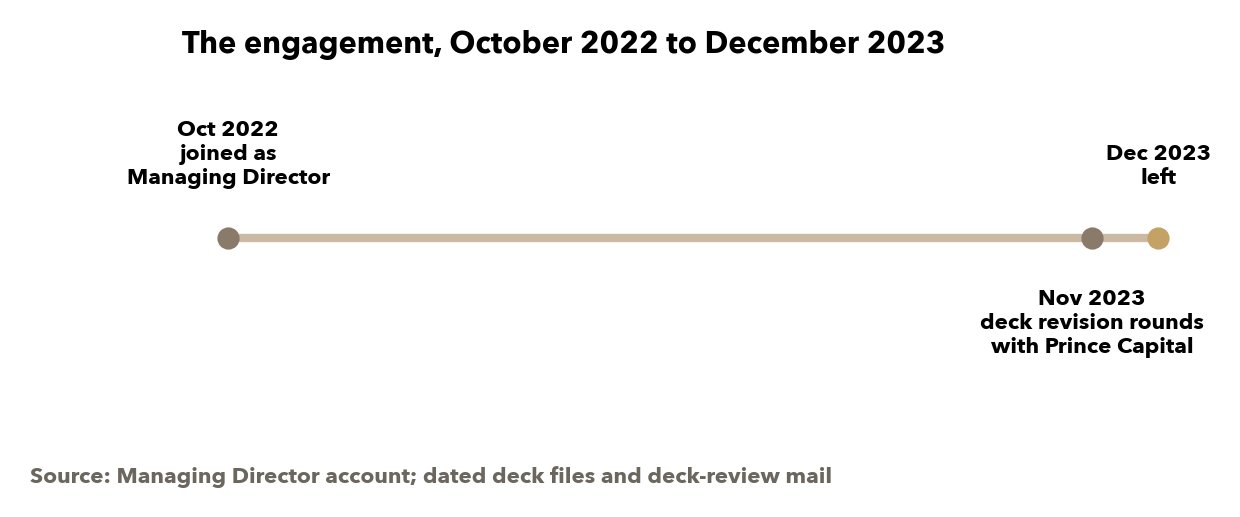
Commitments toward the target came in over fourteen months. The commitments did not fund; the fund did not close near target; the seat ended in December 2023. Two things outlived the fund: the follow-up cadence, which I have used since, and the relationship that came out of the 55-plus community concept rather than out of the raise.
A slice of the project list
A few related projects.
- The Triangle, Grand Avenue: feasibility and go-to-market, capital last (2026)
- 301 W Osborn: development strategy and entitlement (2024 to present)
- A ranch-land sponsor diligence (Mountain West, 2025 to 2026)